Cat laws and human behaviour: a personal story and theory
By Angela Hoskins
During September, while I was driving on the island, a cat crossed the road in stealth mode, slinking low and slow. Two bush stone-curlews were on the roadside, wings outstretched, their stance protective and defensive. I stopped the car. The cat was very close to the birds and I shooed it away in no uncertain terms. Then I took a photo. But the picture I got was meaningless ... by then it was just a cat on the road glaring at me from a distance and away from the birds. I hadn’t seen if the curlews had been protecting chicks but I figured it was likely: during September there were baby curlews, newly hatched, on every block.
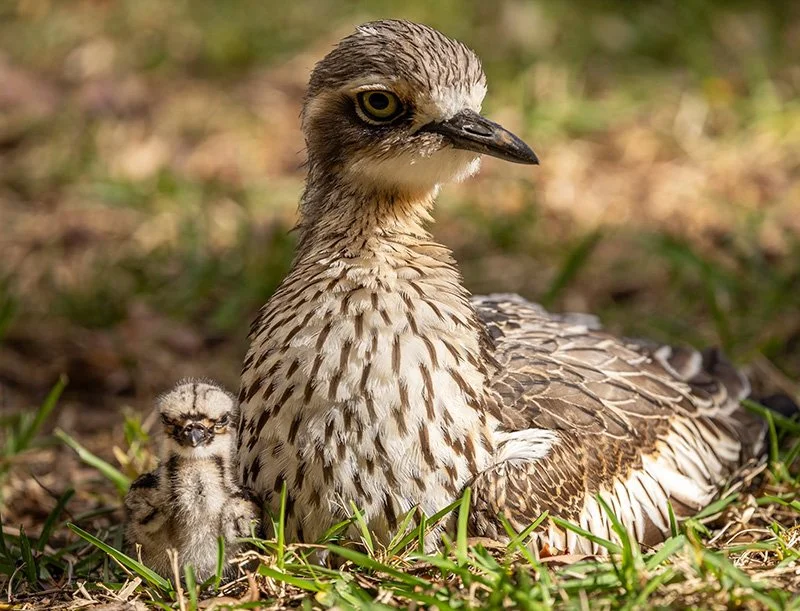
Bush stone-curlew with its baby on the island | Photo by Nicholas O’Brien, Facebook, 21 September 2026
I wondered which household owned the cat and soon found out. The owner had seen me take the photo and came onto his verandah to tell me that the cat was his. I said something like: oh good because I was about to knock on doors along the street to find out who owned it. Then, Resident-123 said, ‘I hate people like you’.
I refer to him as Resident-123 because he presented as one of a number of island residents who consider that their cats can roam free on the island whenever they want. Posts and comments to the island’s private Facebook group verify this.
My reply? ‘I hate people like you too. Take your cat inside, it was attacking the curlews’. That’s the best I could come up with at the time. I went home rattled, seething, and wondering why some people undervalue native wildlife. It makes no sense. Been trying to work it out since.
Do people who ignore cat laws undervalue native wildlife?
I ask this question because Australia’s cat laws are in place to protect our native wildlife yet too many cat owners refuse to comply. Is it that cat owners who shun the laws are ignorant about how vulnerable our native species are when cats roam in our environment?
Some humans do not believe they are subject to laws. This type of human rejects government legitimacy or the democratic rule of law (unless a law directly benefits them). These types immerse themselves in conspiracies to justify their views (Lowy Institute: The global sovereign citizen movement).
Or maybe, for some, our cultural or societal heritage plays a part: if, in years gone by, we owned cats that roamed wherever they wanted, why can’t cats do the same now?
Either way, for some humans, animal management laws can feel like an imposition that impinge on their freedom and their cat’s freedom: Anger can escalate, sadness too, as humans pine for happier days long gone, and what current times present.
‘Right to roam’ … it’s a British thing
Not just a British thing: In the UK, Europe, and some other countries, cats have the ‘right to roam’.
Australia’s population is dominated by those with British heritage. Coochiemudlo Island also has a high percentage of residents with British heritage. Allowing cats to roam outside has been deeply embedded in British culture and societal norms. But does this make it okay to allow cats to roam here? Australia’s natural environment is so different to Britain’s. That said, it’s interesting to note that UK attitudes towards roaming cats could now be changing if the comment thread of this recent Reddit post is anything to go by.
Depending on cultural background and experiences, our attitudes to cats in the environment will be different. There’s no suggestion here that everyone who was born in Britain, or who has with British heritage, allows their cats to roam. Nor am I suggesting that the majority of Coochiemudlo Island cat owners allow their pets to roam.
Australia is not alone when it comes to having cat laws that confine cats to properties — no cats wandering or prowling, at least in most municipal areas. Canada, USA, and South Africa have similar or the same cat laws as Australia. As does New Zealand: they share Australia’s concerns about cats in the environment and are aiming to eradicate all feral cats by 2050.
What’s at the core is that many countries want to protect their native species. Australia’s fauna is like no where else on Earth — feral and roaming cats are among the predators that kill them. Here’s a snapshot of Australia’s colonial history and why many of our native fauna are so vulunerable.
Three species that British colonists introduced to Australia
The following introduced predators have caused wholesale destruction to Australia’s native fauna and ecosystem. Ignorance would have played a part in their introduction to land on the other side of world. But the following information points to a human tendancy to be rooted in cultural tradition which, depending on context, is not necessarily a good thing.
European red foxes were brought to Australia in the 1800s by British colonists so they could continue with their traditional sport of fox hunting. Today, the fox population in Australia is estimated to be around 1.7 million. They are one of the most devastating invasive predators in the country (Invasive Species Council). Foxes hunt wildlife, they eat eggs and young animals, and disturb ground-nesting birds. (Field of Mars Environmental Education Centre).
Rabbits arrived with the First Fleet. Initially, they were contained in hutches for breeding a meat source, or even as pets to remind them of ‘home’. In 1859, fourteen wild rabbits were released onto a wealthy settler’s estate in Victoria — to shoot for sport. By the late 1940s, the rabbit population had increased to 600 million. For context and as a comparison, it took 700 years for rabbits to spread throughout Britain, a small land mass compared to Australia. In Australia, it took 70 years for rabbits to spread throughout the continent. The rapid increase to the rabbit population throughout Australia has been the fastest of an introduced mammal anywhere in the world (National Museum Australia).
Cats arrived in Australia with the First Fleet in 1788 as pets. By 1820, feral cat populations were established around Sydney. By 1890, feral cats colonised 90% of Australia including major inhabited islands (Wikipedia). Feral cats have contributed to the extinction of more than twenty Australian mammal species, including the pig-footed bandicoots, lesser bilby and broad-faced potoroo. Many other species are now endangered (Dept of Climate Change, Energy, the Environment and Water). Many of our native animals are small enough to be preyed upon by cats. Today, the estimated number of pet cats in Australia is more than 5 million (Biodiversity Council).
Cats would have first arrived on Coochiemudlo Island with, or soon after, the white settler population turned up around the start of the 20th century. Bandicoots were here then but numbers have dwindled since, maybe there aren’t any left — I have never seen one on the island. Water dragon lizards used to frequent my unfenced place but not any more. I saw a blue tongue lizard when I first arrived to live on the island in 2019, but not since. But I see too many roaming cats.
During the late 1800s, naturalists began noting declining numbers of wildlife in bushland close to urban areas. However, it would take another 100 years or so for the Australian government to formally recognise the ecological damage caused by cats: in 1992 they listed feral cat predation under the Endangered Species Protection Act 1992 (Dept of Agriculture, Fisheries and Forestry). This Act kickstarted discussions that filtered thoughout communities to challenge and change the old traditional approaches to cat ownership by introducing responsibilities. Some refuse to heed the call.
Humans can also be slow learners. But, over time, we do learn.
An interesting sidenote about dingoes since colonisation
Dingoes, an apex predator, are Australia’s only native fauna species that can that can hunt and kill the introduced species listed above. However, dingo numbers in the wild have declined over the years, the main causes being interbreeding with domestic dogs and eradication from being shot, trapped or baited. Since colonisation into current times, Australia’s governments and private control programs protect livestock by treating dingoes as pests.
My encounter on the island with Resident-123 occurred during the week before I went on a trip to rural NSW. Because it was fresh on my mind, I related the story three times to different groups of family and friends. Interestingly, each time I was asked, ‘Why are cats allowed on the island?’
I wish I could have answered ‘because all cat owners on the island respect animal management laws’. Except that, as the story goes, is not the case on Coochiemudlo Island.
Some Australian islands have tighter cat laws
Islands are particularly at risk from extinctions of native species because of the impact of feral cats on biodiversity. Feral cats are the same species as domestic cats.
To protect native wildlife, the following Australian islands have introduced stricter rules, containment mandates, desexing rules, or phase-out policies regarding cat ownership:
Christmas Island (Austalia territory): Feral cat eradication program includes registration and desexing of domestic cats No further cats are allowed onto the island as pets (Dept of Climate Change, Energy, the Environment and Water).
Kangaroo Island (South Australia): On track to become one of the world's largest inhabited islands free of feral cats under a community-driven and Australian government plan. A proposal to ban new pet cats on the island has been championed by the island’s mayor, Michael Pengilly, and welcomed by the community (ABC News, March 2026).
Bruny Island (Tasmania): Enforceable, stricter domestic cat laws are in place with programs to help support cat owners to comply with the Bruny Island Cat By-law 2018. Bruny Island has been identified nationally as an island with species of conservation significance: Kingsborough Council’s approach to managing feral cats on the island is to first control pet cats, no roaming. Feeding of stray cats is prohibited, stray cats must be reported (Kingsborough Council).
Lord Howe Island (Australian territory): Cats have been eradicated from the Lord Howe Island group. The island introduced a domestic-cat ban in 1982 to protect its native wildlife (Lord Howe Island Museum).
Does Coochiemudlo Island need tighter cat laws? This loaded question shouldn’t need to be asked — it wouldn’t be asked if all cat owners stuck by our Council’s animal management laws. Redland City Council states that resident cat owners must comply with Council’s Local Law 2 which requires cat owners to microchip, register, and properly confine their cats to the owner’s property — which means restricting them from roaming.
Sidenote: interesting stats and facts
An investigation in 2023 by ABC Radio Brisbane found that more than 8,200 cats were captured and impounded, within a 12 month period, by city councils from Moreton Bay to the Gold Coast.
Each year, about 180,000 cats (and 210,000 dogs) are taken into care by councils, either directly or via shelters contracted to care for these pets when the owners no longer are capable to care for them (Pet Rescue).
In Queensland, body-worn cameras are widely used by animal compliance, wildlife, and local council officers to protect staff against a rising wave of public harassment, aggession, and verbal or physical threats (RSPCA Qld Facebook). Societal resistance remains an issue in relation to animal compliance.
Thoughts about cat-owner joys, stresses, breeds and training
Having a pet provides humans with benefits for social wellbeing, mental health, and physical health. Looking after an animal can reduce stress levels and relieve feelings of loneliness and isolation.
Pet ownership can also bring on significant stress. There are emotional, financial, and logistical challenges that can affect mental health. Separation anxiety is stressful for pets and their owners — even cats experience separation anxiety (Save a Pet Foundation Ltd).
The consequences of having an untrained pet, or even an unsuitable pet for where we live, can be a pain in the neck. Not many of us think about training a new pet even though laying down some simple rules at the start can alleviate many pet-related stresses over time.
Cat breeds to avoid would be those known for their hunting prowess. A cat owner with a breed that is more adaptable to indoor living is likely to have an easier time complying with the laws thereby decreasing the stress factor, or increasing the joy factor.
Cat runs and lead harnesses: Constructing a cat run is a safe way to let them be outside, but this can be in the too hard basket for some — practically and financially. From time to time, I have seen owners taking their cat for a walk on a harness lead. Humans can be intelligent.
Training a cat to be comfortable with a harness could be challenging, depending on the breed and age of the cat … The first video that follows is from Australia — it’s informative and with practical tips. The second video was produced in the USA but it’s relevant — and it does offer some light relief, maybe even a laugh. Humans like to laugh.