On the table: New subdivision for Coochiemudlo Island
On 20 October 2025, an application to reconfigure Lot 296 on Coochiemudlo Island was submitted to Redlands City Council (RCC). The proposal is to subdivide the 1.9205 hectare parcel of land into 24 lots or house blocks. The parcel of land is at 296-314 Victoria Parade West, Coochiemudlo Island.
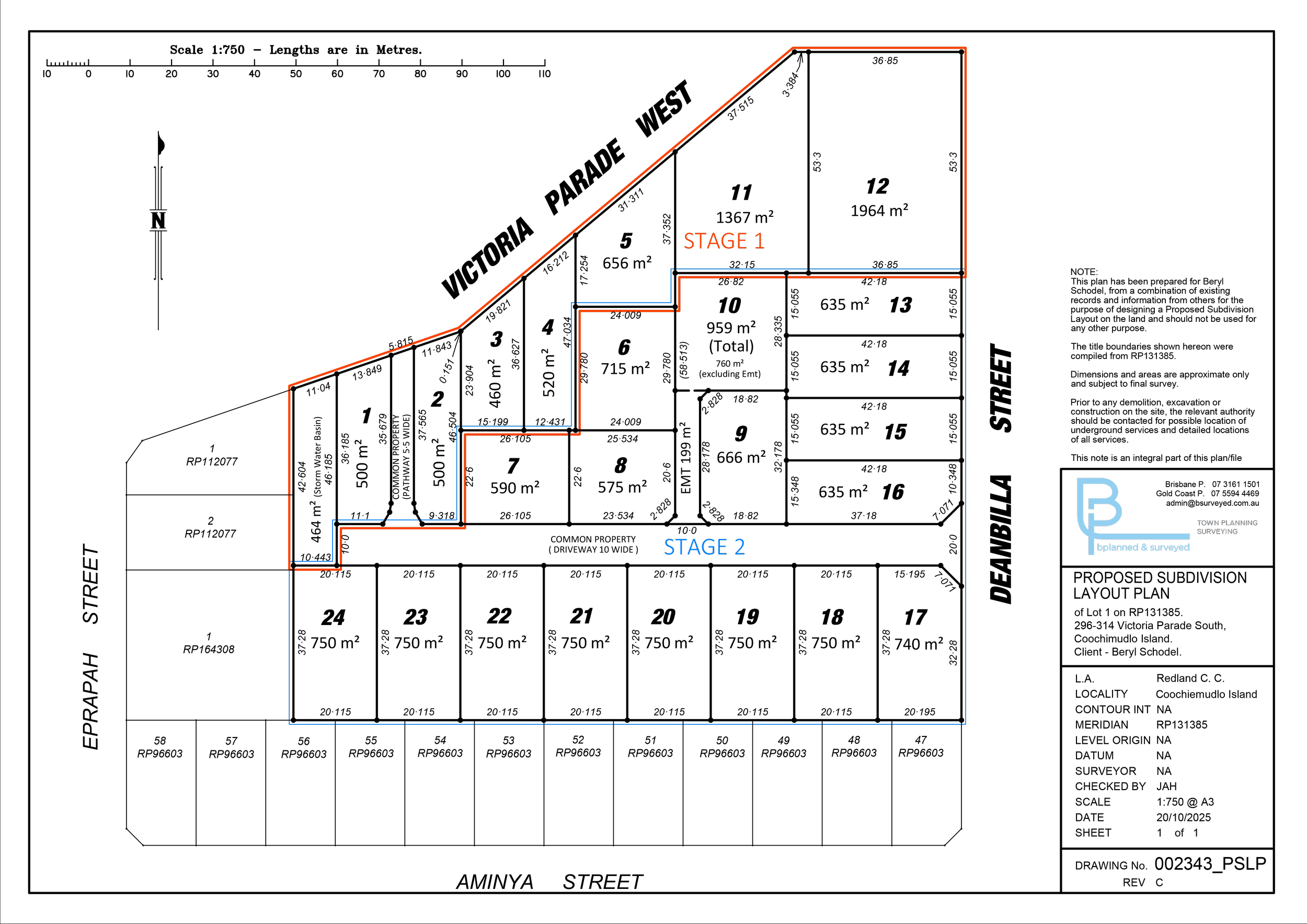
The proposed subdivision plan submitted to RCC as part of the application to reconfigure a lot: RAL25/0075. The plan incorrectly states the address as Victoria Parade South — it should be Victoria Parade West.
The above proposed subdivision layout plan clearly outlines the proposed new 24 lots of residential house blocks to be deleveloped over two stages. The blocks vary in size: the largest block at 1964 square metres, the smallest at 460 square metres, with numerous block sizes inbetween.
Subdivision concerns expressed at public meeting
This proposed subdivision was top of the agenda at Coochie Progress Association’s public meeting held on Saturday 8 November, 2025. Many island residents attended the meeting.
What our council rep stated
Councillor Lance Hewlett (RCC’s councillor for Coochiemudlo Island and Victoria Point) was at the meeting to present the meeting information an overview of the application and the expected process. The following points have been paraphrased from what he said:
Lot 296 is zoned LRD — low density residential. The application is deemed code accessable which means that it is one that typically fits the LRD zoning within the locality.
Although there are the standard environmental impact studies to be completed as part of RCC’s approval process, Lance can’t see why development would not go ahead. He did state that anyone can email him to express concerns about the subdivision. (See Councillor Lance Hewlett’s details here.)
When comparing proposed developments on Coochiemudlo Island with the Southern Moreton Bay Islands, it must be noted that the SMBIs have a major infrastructure limitation in that none of the SMBI islands have a sewerage system, nor town water — they rely of rainwater.
That Coochiemudlo Island has a sewerage system and town water from the mainland is another deciding influence to greenlight the subdivision proposal on the Island.
What residents said at the meeting
One resident who knows the developer/owner of Lot 296 told the meeting that the initial subdivision plan was for the reconfiguration to be 10 blocks. RCC persuaded the owner to increase the configuration number to 24 new blocks, and the owner made that change to her plan. Although Lance was unaware of this background information, he did state that RCC would have ‘discouraged’ the landowner from the 10-block proposal ‘because of the zoning’.
Please note: I have emailed RCC’s planning department to verify this information. If tRCC did persuade the owner to increased the number of losts, I also asked the planning department to provide their metrics for establishing how developments are mapped out, according to lot size, for developments in low density residential zoning.
The general mood at the meeting was one of level-headed-acceptance that the development proposal will go ahead.
That said, there was concern and questions voiced about the impact to the Island of an additional 24 households.
So, the general mood also included residents expressing the importance that RCC makes decisions about the planned proposal that are based on the understanding that small islands have different factors to consider compared to mainland environments and communities. As outlined in the issues listed below, an additional 24 households on Coochiemudlo Island will impact the island’s environment and community.
Mainland parking shortage — a major stressor
The long-standing shortage of mainland parking is a significant stressor for the vast majority of Coochiemudlo’s residents, especially on Fridays, weekends, and holidays. It’s safe to say that the mainland parking problems will increase as the Island’s population grows — more households on the island easily equates to more demand for mainland parking. One unless the hou.
Lance stated that mainland parking for island residents is not factored into the planning process for this new subdivision because RCC is not obligated to provide Coochiemudlo Island rate payers parking on the mainland. Almost every (if not all) island community in Australia that relies on water transport to and from the mainland is experiencing the same parking issues that we are faced with. Lance told the meeting that he gets lots of complaints from Victoria Point residents that Coochiemudlo residents are taking up their street parking spaces in Colburn Avenue. In short, there is not enough land available at Victoria Point for parking. Neither are there any plans to develop a solution for the parking problem considering that Council must provide recreational land for Victoria Point residents. In addition, stormwater runoff issues from concrete carparks would also dissuade the planners away from a decision to build a carpark.
It was also voiced at the meeting that parking on the mainland must be addressed if RCC accepts the plan to open up 24 new residential blocks Coochiemudlo Island. One voice added that Coochiemudlo Island became residential in the 1960s, sewerage was connected in 2006, but mainland parking options have been reduced.
An aside: Island lifestyles work well for many people and households, but …
… perhaps it would be important for anyone thinking of living on Coochiemudlo Island to factor in the current mainland parking shortage into their decision making and plans considering there is not plan, now or projected into the future, to improve the shortage of parking spaces.
Island parking spaces near the ferry
Parking spaces near the ferry are limited. With more households on the island, this limitation will impact more people. Lance informed the meeting that the Island’s carpark area between the ferry and barge will receive funding for an upgrade in the next funding round.
Stormwater drainage and runoff
With a residential development comes with laying lots of concrete and roofs. Concrete and bitumen will cover roads and driveways within the new subdivision. Rooves and downpipes will channel lots of rainwater into stormwater drains and out to the shoreline.
Stormwater runoffs that drain onto the island’s beaches do cause significant erosion during periods of prolonged, heavy rain. Planning for an increase to stormwater runoff through the Emerald Fringe will need special attention within an environmental impact assessment of the proposed subdivision.